





03 Mar Ingenuity and the Benefits of Opportunity Spotting
There’s a lot of talk in business about innovation and creativity, but perhaps not enough about ingenuity and imagination.
Ingenuity, as the word implies, is all about using your genuine or genius creative imagination to best effect. And the more you try, the luckier you get. Funny that.
That’s why I often show a slide that sums up opportunity spotting and gave me the best break of my career.
It’s a photo of a man jumping mid-flight while wielding a sword and dressed in martial arts garb. When I ask people who they think it is they’re either stumped or jokingly suggest it is Bruce Lee or Jackie Chan.
To me the photo = opportunity which is why I keep it close to hand as a constant reminder of the need to seek out new openings.
The man is actually a wushu competitor – wushu being a national sport of the world’s biggest nation, China. Wushu is split into two disciplines: an enthralling fighting style that enables competitors of different styles and sizes to take on opponents, so a diminutive kick boxer can take on a huge sumo wrestler with both having an equal chance to win, and carefully choreographed kata movements in which competitors perform intricate martial arts routines while wielding weapons. Not easy.
So let me explain: why wushu?
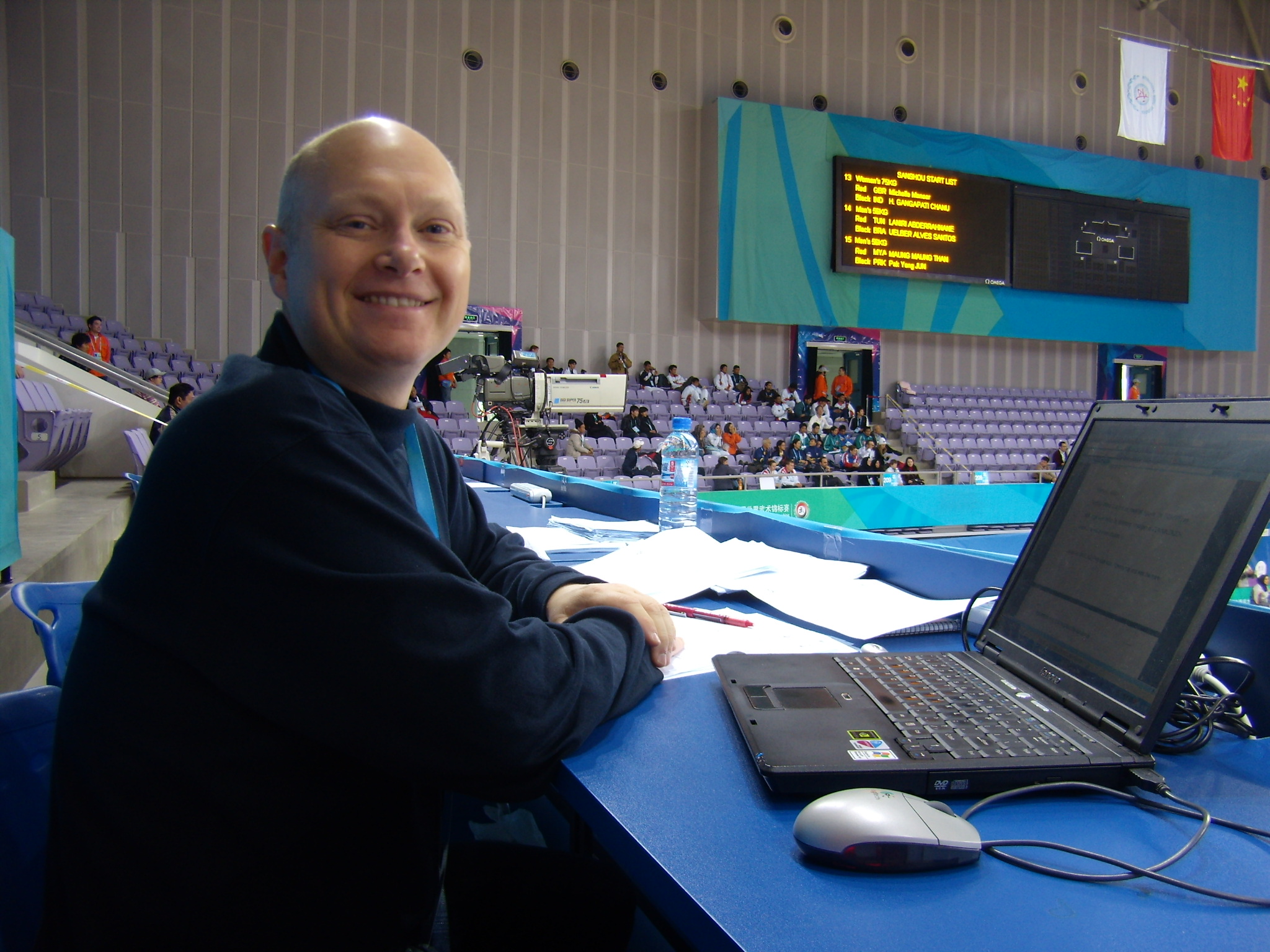
One hectic November morning in 2007 I received a phone invitation to become the tournament journalist for the World Wushu Championships that were being held in Beijing a few weeks later.
At the time I was bogged down in the detail of a heavy work schedule and with the call coming from someone with a heavily affected Chinese accent I suspected it to be a colleague having a joke.
It wasn’t that far fetched. A year earlier I had worked as a website journalisted at the 2006 Asian Games in Qatar and, alongside several other combat sports, I had covered wushu as I knew little about it and wanted to expand my knowledge.
The call turned out to be real enough and the offer genuine – but did I really want to travel to the Far East for a reasonable but not extravagantly paid ten day gig?
After some thought the answer was ‘yes’.
My rationale had less to do to wushu, more the fact the world championships was a test event for the following year’s Olympic Games – the sort of practise major tournaments need to test operations and procedures. I was well up for working at the Olympics in one capacity or another.
Coupled with the opportunity to spend a few days sightseeing in Beijing and visiting famous tourist sites such as the Forbidden City and Tiananmen Square, I went to seek out who I needed to speak to secure a gig at the Olympics.
I enjoyed my week-long work stint and worked with some amazing colleagues – and didn’t have to worry about searching for contacts as the Games’ head of communications, who had studied at Goldsmiths College as I had, came looking for me.
An offer duly arrived early in the new year to head back out east the following May as the official Beijing 2008 Olympic Games website’s chief sports correspondent – a cushy number to write daily summaries and feature articles on notable competitors and help train some of the young Chinese journalists working on the website who lacked experience of writing for a western audience.
Not long after I arrived, the senior English editor quit so I was asked to take on the role – a huge honour which turned out to be the proudest achievement of my journalism career. I wasn’t a sports editor or even been primarily a sports reporter but was seen as a popular member of the team and safe pair of hands. The job demanded immense responsibility to get things right both for the Olympic movement and China as the host nation.
The next few months were hard work but once we’d fleshed out a workable schedule to enable our small team to cover the weight of competition crammed into just 17 days, in the process breaking things down into bite-sized chunks so each team member could specialise on specific sports and get to know its key competitors inside out, it became a real joy.
Moreover the palpable tension that was there when I’d arrived began to ease and we began to see every day as pleasure not pressure.
We built the credibility of the site by reporting incessently on that summer’s pre-Olympic competition. Our daily digest and indiviual reports amassed an online following and whizzed us to the top of the search engine rankings. Better still, our authority wasn’t just based on back end fiddly SEO and any old content but quality articles and insight. Crucially, being in the Far East, our reports went live well before most people in the western world were out of bed.
Imitation being the sincerest form of flattery, many of our articles were little more than cut and pasted by the world’s online news agencies. More credibility.
There was also less haste, more speed. Ninety-five percent of the result reports we posted went live within three minutes with subsequent detailed reports and photos posted within 30 minutes. Our team knew their stuff and got ahead of the game.
During Games-time, I worked 18 to 20 hours a day – not because I had to but because I wanted to lead, guide and support my hard-working team. One of them said one night: ‘We’re making history’. Indeed we were – and indeed we did.
I’m able to look back with huge pride – not just at what we achieved as a team, which was immense, but how I’d seized the opportunity that came about in the first place.
Sometimes opportunities come from unexpected quarters and can often seem to be not that big at first but with a little foresight and imagination they can materialise into career, business and life changing opportunities.
Too often we define innovation solely in terms of high tech and ignore the chance to generate business by using our guile and ingenuity to devise fresh ways of providing our products and services in better, more relevant, and imaginative ways than our competitors or how we can choose to take them to market.
These are lost opportunities which, with a little ingenuity, we can turn to our favour.
Ingenuity – Opportunity spotting and how to stand out from the crowd – is the theme of our CGM Business Media Club meeting on Friday, March 31 from 10am to midday. For further information and to book your seat visit our Business Media Club webpage.
Sorry, the comment form is closed at this time.